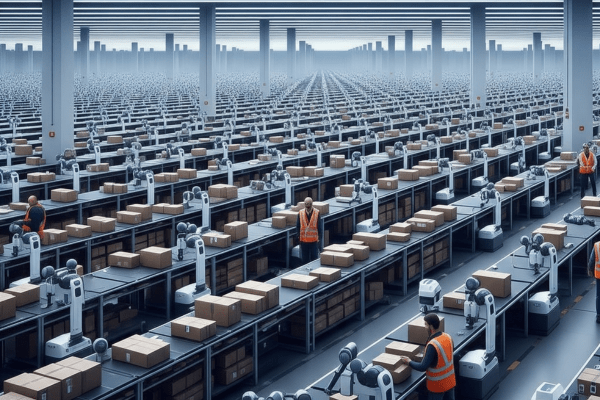

I’ll add one more reason to the internet to hate Amazon. They have just deployed their one millionth robot (that is very hard number visualise!) and while the tech giant celebrates this milestone, the implications of both AI and robotics for human workers are difficult to ignore.
The announcement, made on Monday, marked the arrival of the millionth robot at an Amazon fulfillment center in Japan – in co-incidence whilst Jeff Bezos was enjoying his $50 million wedding in Venice.
One million robots is not just a big number, it’s a massive turning point. According to The Wall Street Journal, Amazon’s warehouse workforce could soon be equally divided between humans and machines. Even more striking: robots now assist in 75% of all global Amazon deliveries.
If you’re concerned that your job could be replaced by artificial intelligence or automation, take a moment to reflect. Amazon hasn’t just put a dent in the job market; it’s torn a hole through it. One million robots working means one million human jobs potentially replaced—a transformation made possible in just 13 years, starting with its 2012 acquisition of Kiva Systems.
DeepFleet, Amazon’s New Generative AI Brain
The robot milestone wasn’t the only announcement Amazon dropped this week. It also launched DeepFleet, a generative AI model designed to orchestrate its massive robotic army with greater precision. Built using Amazon SageMaker and trained on proprietary warehouse data, DeepFleet will reportedly increase the efficiency of robotic navigation by 10%, making machines even faster and smarter than their human counterparts.
This move shows Amazon isn’t just investing in more robots, it’s building better ones. More efficient, more autonomous, and, crucially, less reliant on human oversight. Workers of the future will have no chance.
Meet Vulcan: The Robot That Can Feel
Earlier this year, Amazon unveiled Vulcan, its most advanced robot yet. Vulcan doesn’t just lift boxes, it senses them. With dual arms, cameras, suction tools, and tactile feedback, Vulcan brings the human sense of touch into the machine world. And unlike previous models, it’s capable of rearranging inventory on the fly, suggesting a near-human level of adaptability.
It’s part of Amazon’s broader push toward “next-gen fulfillment centers,” where robot density is expected to be 10x higher than in today’s facilities. The first of these futuristic hubs has already opened in Shreveport, Louisiana.
The Human Cost of Automation
Amazon is quick to highlight how automation supports human workers, not replaces them. But that’s getting harder to believe. Each technological lea and each smarter robot brings us closer to a warehouse with fewer people and more machines. This trend is also pushing through all aspects of the supply chain, from manufacture to delivery.
Let’s be blunt: If you’re worried AI might take your job, you’re not alone. But the story Amazon is writing shows that for a million people, it already has.
Whether you see this as progress or peril depends on where you stand. For Amazon, it’s efficiency. For many workers, it’s redundancy.
The rise of the machines isn’t a sci-fi dystopia anymore, it’s a logistics strategy. As Amazon’s millionth robot begins its shift, the rest of us are left to ask: When it’s your turn to be replaced… who will even notice…and how else can Jeff pay for his wedding extravagances?
Follow Media-M for the latest in Tech, AI, SEO and Digital Marketing



 Media M
Leave a comment