
Tests Suggest It’s More Than a Theory
The world of SEO just got a massive jolt. For months, we’ve speculated about how AI models like ChatGPT gather real-time web data. OpenAI’s official stance is that it relies on Bing for its web Browse, a partnership that makes a lot of sense given Microsoft’s investment. But what if that’s not the whole story?
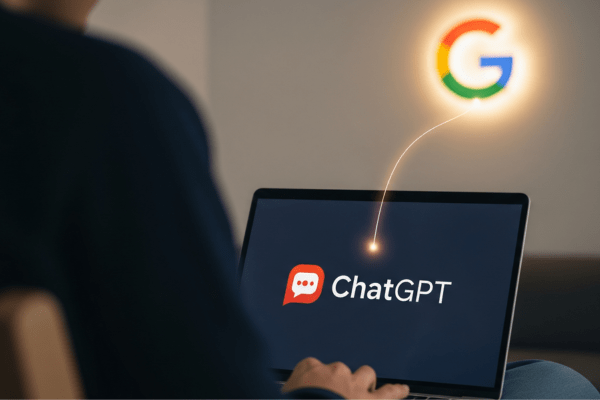
A wave of recent, controlled experiments by SEO experts is adding serious weight to the idea that ChatGPT Plus is using Google Search, and its findings are a wake-up call for every marketer. If your content is only visible to Bing, you might be invisible to the most popular AI chatbot on the planet.
The Experiment That Broke the Code
The most compelling evidence comes from a “sting” operation conducted by Backlinko. They created a brand-new, nonsensical term:
NexorbalOptimization. A dedicated page was published about this term, but with a crucial twist—it was configured so that only Googlebot could crawl and index it. Bing, Claude, and every other crawler were blocked.
The team then asked various AI models, “What is NexorbalOptimization?”
The results were stunning:
- ChatGPT Plus (with Browse) and Perplexity provided accurate answers, directly quoting the content from the Backlinko page.
- Other models, including the free version of ChatGPT and Claude, failed to find the term at all.
This isn’t an isolated incident. The Backlinko test validates a string of similar experiments by prominent SEOs like Abhishek Iyer, Aleyda Solis, and Alexis Rylko. Their findings all point to the same conclusion: visibility in Google’s index directly impacts a page’s chance of being cited by ChatGPT Plus.
Why SEO Isn’t Dead (It’s Just Evolving)
For a while now, the narrative has been that Generative AI could kill SEO. These new findings turn that idea on its head. If ChatGPT is, in fact, sourcing answers from Google, then your work to rank on Google has a powerful second-order effect: it helps your content get seen and cited by AI.
This means that your traditional SEO strategy is now more important than ever. If your content is well-optimized and visible to Google, it has a chance to be the “source of truth” for a whole new generation of AI-powered answers. But if your content is invisible to Google, it’s effectively invisible to these AI models as well.
The Supporting Evidence Is Overwhelming
The Backlinko experiment is just the latest piece of a larger puzzle. Here’s a quick look at the other tests that suggest a powerful, if unofficial, connection between ChatGPT and Google:
- Abhishek Iyer ran a nearly identical “hidden page” test, indexing a new page only in Google. ChatGPT Plus found it, while the free version and other search engines could not. His analysis of ChatGPT’s search references also showed a strong alignment with Google’s data.
- Aleyda Solis found that ChatGPT responses often mirrored Google’s search snippets, even down to the wording. In one test, ChatGPT continued to cite Google’s snippets even after the page was indexed by Bing, where Bing’s own snippet was different.
- Alexis Rylko compared ChatGPT’s internal JSON search logs against live search results. He discovered that up to 90% of the URLs cited by ChatGPT matched the top results from Google, far outperforming the overlap with Bing.
No Comments from the Big Players
Despite the mounting evidence, neither OpenAI nor Google has confirmed a deal. When asked about these experiments, OpenAI responded by highlighting its ongoing relationship with Microsoft but did not deny that it uses a variety of search providers. Google, for its part, has simply declined to comment.
For now, this leaves us with a compelling truth: for paying users of ChatGPT, visibility on Google is the golden ticket to being cited in AI-generated answers. The future of search optimization isn’t just about ranking on a search results page—it’s about earning your place as a trusted source for the AI models that are increasingly shaping how we find information.


 Media M
Leave a comment