
Volatility, Recoveries & AI’s Growing Influence

The Google June 2025 Core Update was a major shake-up in the world of search. Rolling out from June 30 to July 17, it clocked in at just over 16 days, marked by intense volatility, partial recoveries, and fresh signals that AI is playing an increasingly central role in how Google evaluates and ranks content.
Several SEO data providers, including Similarweb, Sistrix, and Semrush, agree: this was one of the most turbulent updates in recent years, arguably eclipsing the March 2025 update in long-term SERP impact.
Data Providers Confirm: This Was a Big Update
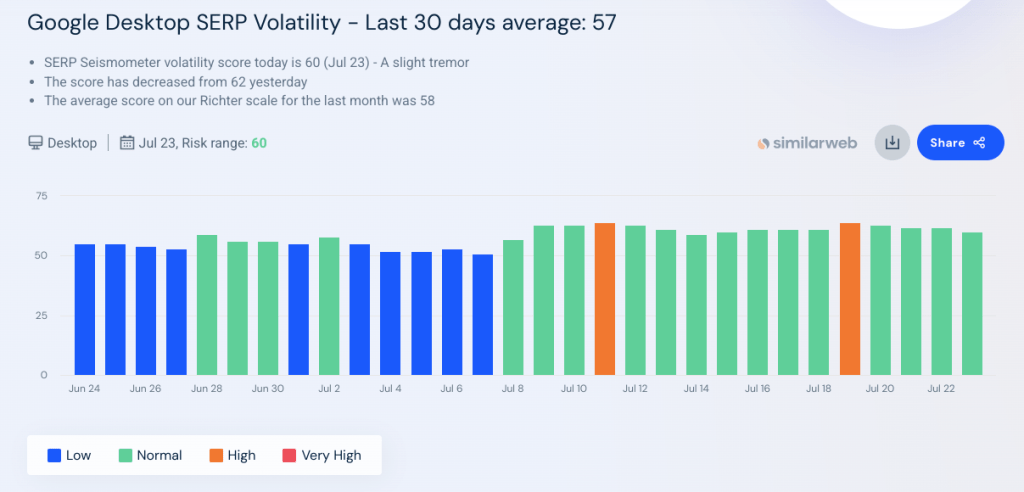
Similarweb: Highest Volatility Since 2024
- July 11 marked the peak of search turbulence according to the Similarweb SERP Seismometer, though early tremors began as soon as July 2.
- When compared to recent core updates (including March 2025), June’s was significantly more disruptive across top 5 SERP positions, particularly in health and retail.
- Interestingly, finance remained relatively stable, reflecting either Google’s confidence in existing rankings or a lack of significant content improvements in that vertical.
“Health experienced markedly high volatility in the top five positions.”
— Darrell Mordecai, Similarweb
Sistrix: Two Waves & Notable Recoveries
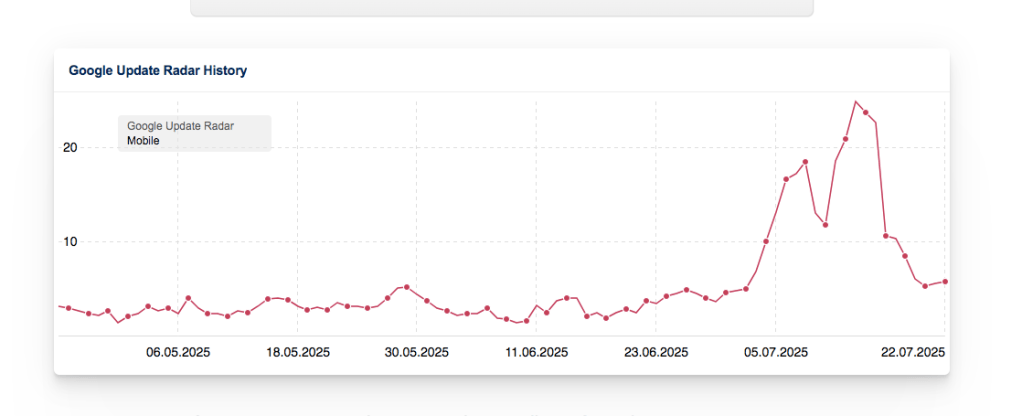
- According to Steve Paine at Sistrix, the June update hit in two distinct waves, affecting a wide range of content types.
- Their radar tool showed significant fluctuations across domains, with a few previously penalised sites seeing notable recoveries, such as Puppies.com, which had struggled post-2024 spam and March 2025 core updates.
- YMYL (Your Money Your Life) content was again front and center, with strong gains or losses tied to content trustworthiness and perceived authority.
Semrush: Bigger Long-Term Shifts Than March 2025
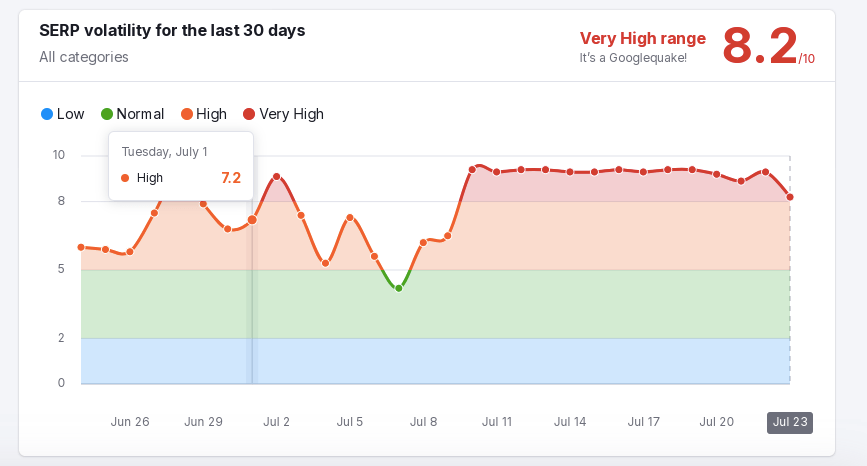
- While the March 2025 Core Update had a sharper initial spike in volatility, Semrush’s Mordy Oberstein argues that the June update’s structural impact may be more significant.
- 16.2% of URLs now ranking in the top 10 had not been in the top 20 before, the highest percentage in 4 years.
- The number of AI Overviews shown also doubled during the rollout, indicating how closely tied AI summaries are to core ranking systems.
“This update wasn’t just about rankings—it was about redefining the relevance landscape.”
— Mordy Oberstein, Semrush
The Semrush Sensor shows the volatility is still very high.
The Real-World Impact: Who Felt It Most?
- Health and e-commerce sites saw some of the biggest swings.
- Brand authority seems to have played a larger role this time, with major retailers and specialist niche brands gaining visibility over generic or lower-quality e-commerce domains.
- SaaS and informational sites were mixed bags—those with deep topical relevance and expert authorship fared better.
“Brands are gaining more visibility for branded and broad product terms… likely a push toward content diversity and user value.”
— Aleyda Solis
Partial Recoveries, But No Full Reversals
A fascinating pattern: some domains hit by September 2023’s Helpful Content Update or early Review Updates saw modest gains.
“The June update triggered recoveries in some domains that had been suppressed for months, possibly due to improvements in content depth or alignment with evolving ranking signals.”
— Glenn Gabe
Marie Haynes added a deeper take, suggesting that Google is shifting away from traditional ranking signals in favour of AI-led content interpretation. That means good UX, genuine helpfulness, and intent matching are now more critical than ever.
What To Do If You Were Hit
Google’s advice remains frustratingly consistent:
“There’s nothing new or special that creators need to do… continue focusing on helpful, people-first content.”
However, that advice rings louder when paired with these key takeaways:
- Audit E-E-A-T signals (Expertise, Experience, Authoritativeness, Trustworthiness).
- Reassess content quality, structure, and purpose alignment.
- Avoid fluff or keyword padding—Google’s systems are better than ever at spotting low-value content.
- Check AI driven campaigns are inline with Google guidelines
Industry Tools Show the Heat
Several popular SERP tracking tools backed up the core update’s intensity:
- Mozcast, Algoroo, Advanced Web Rankings, Accuranker, and Wincher all reported sustained turbulence from July 2–14, with unusual movement in typically stable verticals.
- CognitiveSEO, Mangools, and SERPstat also showed elevated volatility throughout the full rollout window.
AI’s Growing Role in Ranking
The integration of AI Overviews (AIOs) into the core update highlights a growing trend: search is evolving from keyword-based answers to AI-interpreted context and intent.
- AI Overviews were triggered by 20% of keyword queries at the peak of the update, now hovering around 15%.
- This means content that is structured, well-sourced, and intent-aligned stands a better chance of being picked for AI summarisation and top placement.
The Google June 2025 Core Update wasn’t just another algorithm adjustment, it was a signal that Google’s evaluation systems are getting smarter, faster, and more AI-driven.
Whether your site rose, fell, or stayed static, one thing is clear: the days of “gaming” SEO are over. The only sustainable strategy is creating genuinely useful content that satisfies user intent across multiple layers of the SERP.
If you were hit, take a breath. Recovery is possible, but it means being strategic, data-driven, and genuinely helpful.
View more about Google latest Core Update
About the Author
Max Letek is an SEO and digital trends expert. He specialises in core updates, algorithmic volatility, and AI in search. Follow him on LinkedIn for real-time updates on search engine movements.



 Media M
Leave a reply to Google’s June 2025 Core Update Is Now Complete – Media M Cancel reply